
How to Recite Hanuman Chalisa — Best Time, Day & Rules
Best Time to Recite
Brahma Muhurta (approx. 4:00–6:00 AM) — the hour and a half before sunrise — is considered the most powerful time. The mind is fresh, the world is quiet, and scriptures say spiritual practices bear special fruit in these hours.
If Brahma Muhurta is not practical, chant in the morning after bathing, or in the evening at sunset after lighting a diya. Many devotees also recite at night before sleeping for freedom from nightmares and negative dreams.
What matters more than the clock is regularity — the same time every day builds a spiritual rhythm that deepens with practice.
Best Days to Recite
Tuesday and Saturday are the two most auspicious days for Hanuman worship.
- Tuesday (Mangalvar) is dedicated to Lord Hanuman, who is the presiding deity of Mars (Mangal). Chanting on Tuesdays strengthens courage, pacifies Mangal dosha, and invokes Hanuman’s swift grace.
- Saturday (Shanivar) is Saturn’s day. Since Hanuman protects his devotees from Shani’s malefic effects, Saturday recitation is the classic remedy during Shani Sade Sati and Dhaiya.
Daily recitation is ideal; if you chant only on specific days, never miss Tuesdays and Saturdays.
Preparation (Before You Begin)
- Bathe and wear clean clothes — preferably red, saffron, or orange, the colours dear to Hanuman. Purity of body supports purity of mind.
- Set up a clean altar — place a picture or murti of Lord Hanuman (ideally in the Veer or Sankat Mochan form) facing east or north.
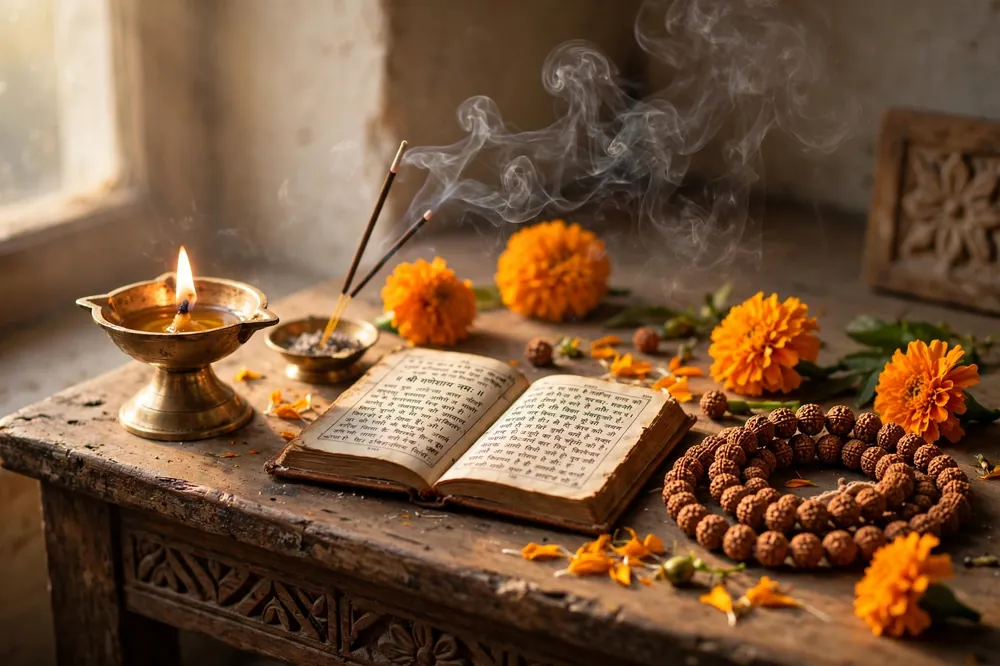
- Light a diya — a ghee or sesame-oil lamp, and optionally incense (agarbatti). Offer red flowers, sindoor, and a sweet or fruit as prasad.
- Sit facing east on a clean asan (mat), spine straight, in a quiet corner.
- Begin with prayer — chant “Shri Ganeshaya Namah”, then “Om Shri Hanumate Namah” or the opening doha (Shri Guru charan saroj raj…), settling the mind before the 40 chaupais.
Recitation Counts: 1, 7, 11, 21, 108
- 1 time daily — perfect for beginners and busy schedules; the foundation of a lifelong habit.
- 7 times — a common Tuesday/Saturday practice for steady blessings.
- 11 times — a popular sankalpa count for fulfilling a specific wish.
- 21 times — an intensive practice for serious vows and major life challenges.
- 108 times — the most powerful anushthan, usually done on Tuesdays or Saturdays with a rudraksha or tulsi mala for counting. Some devotees complete 108 recitations over a day; advanced practitioners do it in one sitting.
The golden rule: choose a count you can sustain. Eleven recitations done daily for forty days outweigh 108 done once and abandoned.
Rules to Follow
- Chant clearly and steadily — neither rushed nor dragging; let each word be heard by your own heart.
- Understand the meaning — even a basic grasp of the verses transforms mechanical repetition into living prayer.
- Maintain purity — bathe before chanting; avoid non-vegetarian food, alcohol, and negative speech on days of recitation, especially during a sankalpa.
- Keep a sankalpa — for special wishes, take a vow: fixed count, fixed days (e.g., 40 Tuesdays), and complete it without break.
- End with aarti and prayer — close with the Hanuman Aarti (Aarti Keejai Hanuman Lalla Ki) and a moment of silent gratitude.
- Be consistent — missing a day during a sankalpa traditionally means restarting the count; for general practice, simply resume with renewed resolve.
Common Mistakes to Avoid
- Rushing through the verses like a chore to finish — speed without bhaav (feeling) empties the practice of its power.
- Chanting with a distracted mind — scrolling the phone between verses or chanting while watching TV divides the devotion.
- Incorrect pronunciation carried on unknowingly — listen to a learned recitation once and align your pronunciation; small, steady corrections are enough.
- Breaking a sankalpa midway — if you take a vow of 11 or 21 days, honour it fully; an uncompleted vow is worse than no vow.
- Treating it as superstition or a transaction — demanding instant miracles breeds disappointment; the Chalisa works through faith, patience, and surrender.
- Neglecting the meaning — chanting for years without ever reading what the verses say keeps the deepest blessings locked away.
Frequently Asked Questions
What is Brahma Muhurta, exactly?
Brahma Muhurta is the auspicious period roughly 1 hour 36 minutes before sunrise — practically, between 4:00 and 6:00 AM. Scriptures consider it the ideal time for prayer and meditation, when the mind is naturally calm and sattvic.
Why are Tuesday and Saturday special for Hanuman?
Tuesday is Mars’s day, and Hanuman — the embodiment of strength and courage — is Mars’s presiding deity. Saturday is Saturn’s day, and Hanuman is the great protector against Shani’s afflictions. Worship on these days aligns with both planetary currents.
Can I recite Hanuman Chalisa without bathing?
Ideally, bathe first — physical purity aids mental focus. But if you are travelling, unwell, or in difficulty, chant anyway: Hanuman values sincere devotion above ritual perfection. Never let imperfection stop the prayer.
Should I use a mala for counting?
A mala (rosary) of rudraksha or tulsi beads is helpful for counts of 11, 21, or 108, keeping the mind anchored. For a single daily recitation, it is optional.
Can I listen to the Chalisa instead of chanting it myself?
Listening with attention is meritorious, especially for the elderly or beginners learning pronunciation. But self-recitation engages breath, voice, and mind together — tradition holds it as the fuller practice. Do both: listen to learn, chant to grow.
What should I do after completing a 40-day sankalpa?
Conclude with gratitude: offer prasad, feed the poor or monkeys (Hanuman’s beloved), and donate to a Hanuman temple if you can. Then either continue daily recitation or begin a new sankalpa — most devotees find they never want to stop.